
Wired Glass Fire Ratings: Specifiers Must Verify the 45 minute Limit

Wired glass can hold a fire-protective rating, typically 20 to 45 minutes, with select filmed products listed to 60 or 90 minutes under strict size limits. It is not fire-resistive glass, and it does not stop radiant heat. Monolithic wired glass also fails modern impact tests, so it’s banned from hazardous locations unless paired with a tested safety film. Before you specify it, confirm the exact listing, the hose stream result, and the exposed area allowed for that rating.
TL;DR:
- Most wired glass carries a fire-protective rating of 20 or 45 minutes, with select filmed products listed up to 90 minutes under strict size restrictions.
- Above 45 minutes, wired glass often fails the hose stream test due to thermal shock, limiting practical ratings to 45 minutes for standard products.
- Wired glass is typically about 1/4 inch thick, with exposure area caps of 1,296 square inches for 45-minute ratings, and it is prohibited in hazardous locations unless modified with a tested safety film.
- Impact safety compliance requires the use of safety films tested together with the glass and frame, not applied after installation without proper listing.
- Proper specification demands detailed review of test reports, impact classifications, label visibility, and assembly matching to ensure code compliance and inspection approval.
Table of Contents
- Wired Glass Fire Rating Standards: 20, 45, 60, and 90 Minutes
- How Wired Glass Performs in Fire Tests
- Code Limits, Labels, and Where Wired Glass Is Prohibited
- Impact Safety Rules and When Retrofit Is Required
- Specification Checklist for Ordering Wired-Glass Vision Panels
- How Universal Fireproof Doors Supports Compliant Glazed Assemblies
- Retrofit, Replacement, and NFPA 80 Compliance
- Certification Labels and Marking Requirements
- Specifying Wired Glass Within Fire-Rated Frames and Door Assemblies
- Wired Glass Limitations in Wet Locations and Hose Stream Exposure
- Code Acceptance: Wired Glass vs. Alternative Glazing Materials
- What Actually Matters When You Specify Wired Glass
- Get Compliant Fire-Rated Door Assemblies Without the Delay
- Standards to Attach to Your Submittal
- Sources
- FAQ
Wired Glass Fire Rating Standards: 20, 45, 60, and 90 Minutes
Most wired glass in circulation carries a 20-minute or 45-minute fire-protective listing. The 20-minute rating is common in door lites and transoms partly because many jurisdictions exempt 20-minute assemblies from the hose stream test, which makes that threshold easier for standard wired glass to clear than higher ratings. The 45-minute rating is the practical ceiling for most uncoated wired glass and shows up constantly in corridor doors and small vision panels.
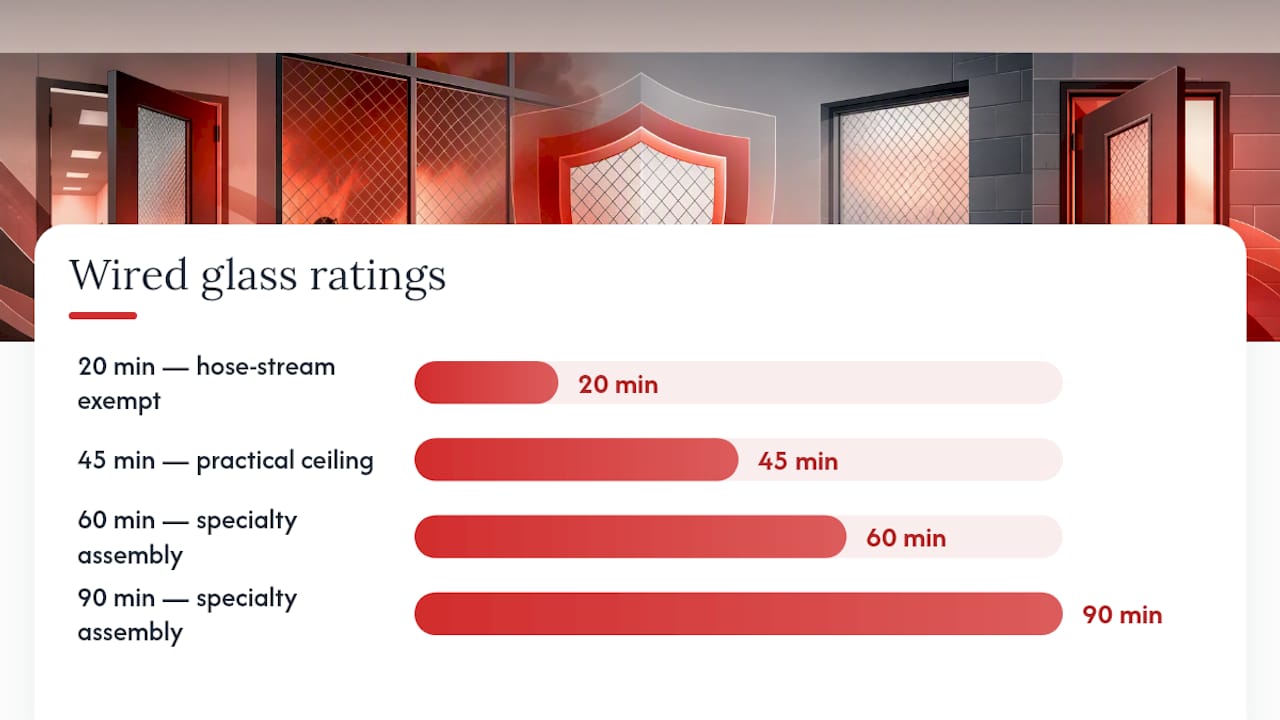
Sixty and 90-minute listings exist, but only for specialized filmed or laminated wired glass products tested as a complete assembly. Those listings come with tight dimension caps, so a 90-minute door rarely gets a large vision lite.
A few patterns hold across most projects:
- 20-minute doors: interior corridor doors, closet doors, low-hazard partitions.
- 45-minute doors: stairwell doors, corridor doors in occupancies with moderate fire loads, standard vision panels.
- 60 to 90-minute openings: typically require fire-resistive glazing instead of wired glass once the lite exceeds the small area caps allowed for specialty products.
If a project calls for a large glazed area at 60 minutes or above, wired glass is usually the wrong material choice from the start.
How Wired Glass Performs in Fire Tests
Fire-protective glazing gets tested through furnace exposure that measures how long the assembly blocks flame and smoke, following ASTM E119 or UL 263 protocols. Wired glass typically passes this phase well because the embedded wire mesh holds cracked glass in place instead of letting it fall out of the frame.
The complication comes next. Ratings above 45 minutes require a hose stream test, where firefighters’ water pressure hits the assembly immediately after furnace exposure. Many wired glass products cannot survive that thermal shock intact, which is exactly why 45 minutes functions as the practical ceiling for standard products.
Quick fact: wired glass blocks flame and smoke by staying in its frame under heat, but it transmits radiant heat almost as fast as ordinary glass. That’s the core distinction between fire-protective glazing (wired glass) and fire-resistive glazing (multi-layer, tested to ASTM E119 or UL 263), which actually limits temperature rise on the unexposed side.
Code Limits, Labels, and Where Wired Glass Is Prohibited
Fire door labels aren’t decorative. Each stamped letter tells an inspector something specific, and misreading one is a common cause of failed inspections.
- D marks the label as valid for door assemblies.
- H indicates suitability for window frame assemblies.
- T signals a temperature-rise rating for use where heat transmission through the door itself is limited.
- OH applies to horizontally sliding or rolling fire doors.
- W designates window assemblies.
- The number that follows (20, 45, 60, 90) states the minute rating in that specific test.
Size limits track directly with rating. Under the 2012 IBC framework, a 20-minute door has no glazing area limit, a 45-minute door caps exposed glazing at 1,296 square inches, and 60 to 90-minute panels drop to roughly 100 square inches with additional height and width restrictions. Three-hour rated assemblies don’t allow vision glass at all.
Wired glass is also flatly prohibited in hazardous locations defined by building codes, including doors and sidelites within reach of foot traffic, unless it’s been modified with a tested safety film. Specifiers working in schools, healthcare facilities, or any occupancy with strict egress requirements should assume monolithic wired glass won’t clear plan review without that modification.
Impact Safety Rules and When Retrofit Is Required
Monolithic wired glass fails the impact tests that govern hazardous locations today. That’s not a gray area. Codes require compliance with CPSC 16 CFR 1201 Category I or II, or ANSI Z97.1 Class A or B, and plain wired glass shatters in a way that doesn’t meet either standard.
Filmed wired glass changes the equation. When a safety film is applied and tested together with the glass and frame as one assembly, the product can pass both the fire test and the impact test. The key word is “together.” A film applied after the fact, without its own listing for that exact glass and frame combination, doesn’t count.
- Broken wired glass in an older door almost never gets replaced with more wired glass; current codes push toward safety-rated substitutes.
- An occupancy change (say, a storage room converting to a classroom) can trigger a full glazing review even if nothing physically broke.
- Adoption of a newer IBC or NFPA edition by the local authority having jurisdiction can retroactively flag existing wired glass installations.
Pro Tip: Keep a copy of the original test report for every glazed opening in your building files. When something breaks or an inspector asks questions, that document is the fastest way to prove what was originally installed and whether replacement-in-kind is even legal.
Specification Checklist for Ordering Wired-Glass Vision Panels
Ordering wired glass without paperwork in hand is how noncompliant installs happen. Walk through this sequence before you place an order:
- Request the full test listing. Ask for the specific NFPA 252, NFPA 257, or UL 10C/10B report number, not just a general “fire-rated” claim on a spec sheet.
- Confirm hose stream results if the rating exceeds 45 minutes. A product without a documented hose stream pass has no business in a 60 or 90-minute opening.
- Verify the impact classification. Get the CPSC 16 CFR 1201 category or ANSI Z97.1 class in writing, and confirm it applies to the glass, film, and frame as a single tested assembly.
- Check exposed area against your rating. Measure the actual vision lite dimensions against the applicable IBC cap before you finalize the design.
- Confirm thickness and mesh specs. Standard wired glass runs about 1/4 inch thick with specific wire gauge and mesh size requirements; get these in the product data.
- Require label photos before installation. Ask the supplier for photos of the permanent label on the actual glazing before it ships, and again once it’s delivered.
How Universal Fireproof Doors Supports Compliant Glazed Assemblies
The company manufactures and supplies fire-rated steel doors and frames built to documented listings, with options for fast delivery to support contractors working against compliance deadlines. That speed doesn’t replace verification. Specifiers should still request lab reports, label photos, and installation instructions that match the exact assembly being delivered, regardless of supplier.
A reliable workflow looks like this: confirm the listing at submittal stage, request pre-shipment label photos, and retain the test reports in your operations and maintenance files. Installation and maintenance services should be supported by thorough documentation, since a fire door assembly is only as compliant as the associated paperwork.
Retrofit, Replacement, and NFPA 80 Compliance
NFPA 80 governs the inspection, maintenance, and repair of fire door assemblies, and it treats glazing as part of the assembly, not a separate item. When wired glass in an existing opening cracks or breaks, replacement with more monolithic wired glass is frequently not acceptable under current adoption of the standard, especially in hazardous locations.
NFPA 80 requires annual fire door inspections in most commercial occupancies, and a cracked or improperly labeled lite is one of the most common findings that fails an inspection outright. If your facility still has original wired glass installed decades ago, don’t assume it’s grandfathered indefinitely. Many authorities having jurisdiction apply current impact-safety rules retroactively once a pane is damaged, which forces a real decision: replace with filmed wired glass tested to both fire and impact standards, or move to fire-resistive glazing if the opening size demands it.
Documentation matters here as much as the physical replacement. Keep records of what was installed, when, and under what code edition, because an inspector asking for proof of compliance won’t accept “it’s always been like that” as an answer. A missing or illegible label is treated the same as noncompliant glazing in most inspection checklists, even if the glass itself would otherwise pass.
Budget for this proactively. Facilities with older wired glass installations across multiple doors often find it more efficient to schedule a phased replacement during other maintenance work rather than reacting door by door as panes break.
Certification Labels and Marking Requirements
Every compliant fire-rated glazing assembly carries a permanent label, usually etched or fired into a corner of the glass itself, not just printed on a sticker that can peel off. That label identifies the testing laboratory, the fire rating in minutes, and the applicable use codes (D, H, T, OH, W as covered earlier).
Inspectors look for legibility first. A label that’s been painted over, scratched beyond reading, or obscured by hardware doesn’t satisfy code, even if the glass underneath is genuinely compliant product. If you’re doing a walkthrough on an existing building, flag any glazing where the label can’t be read from a normal viewing distance.
For new installations, the label needs to match the frame and door labels exactly. A 90-minute door frame with a 45-minute wired glass insert is a mismatched assembly, and it fails as a unit even though each individual component might carry a valid rating on its own. This is why confirming assembly listings matters more than confirming individual component ratings. The glass, the frame, the glazing tape or stops, and any film all need to be part of the same tested combination.
Keep a photo record of every label at the time of installation. It’s a small step that saves significant time during future inspections or if a dispute arises about what was actually delivered versus what was specified.
Specifying Wired Glass Within Fire-Rated Frames and Door Assemblies
Wired glass doesn’t get evaluated as a standalone product when it goes into a door or frame. The whole opening, door slab, frame, glazing, and hardware, gets tested and rated together, so the vision lite has to match what the door assembly was originally certified for.
Start with the door’s rating, not the glass. A 90-minute fire-rated door slab like Ufdoors’ 32 x 84 steel door slab sets the ceiling for what glazing can go into it. You can’t drop in an unrated vision lite just because the opening looks small enough. The frame manufacturer’s listing will specify exactly which glazing products are approved for that particular door and frame combination.
Vision panel placement matters too. Codes typically restrict how close a glazed opening can sit to the door edge, hinge stile, or lock stile, because those areas need enough solid material to maintain structural integrity during a fire. A specifier who wants a large picture-window-style vision lite in a 90-minute door is usually going to run into both the area cap and the placement restriction at the same time.
When in doubt, request the frame manufacturer’s approved glazing list before finalizing the vision lite size. It’s faster to catch a mismatch on paper than during a failed inspection after installation.
Wired Glass Limitations in Wet Locations and Hose Stream Exposure
Wired glass and moisture don’t mix well over time. The embedded wire mesh sits close to the glass surface, and in humid or wet environments, exposed wire ends at cut edges can corrode. That corrosion weakens the bond between the wire and the glass, which can reduce the panel’s performance during an actual fire event even though it looks intact on a visual inspection.
This matters most in industrial kitchens, pool enclosures, exterior vestibules, and coastal buildings where humidity or salt air is a constant factor. If you’re specifying wired glass for one of these environments, ask the manufacturer directly about edge sealing and corrosion resistance, because standard product specs don’t always address it.
The hose stream test exposure limitation compounds this issue. Since ratings above 45 minutes require a hose stream pass, and many wired glass products struggle with thermal shock even in dry conditions, a product installed in a wet or humid environment for years may perform worse than its original test rating suggests. Corrosion isn’t part of the original fire test, but it directly affects the mechanical integrity the wire mesh is supposed to provide.
For any wet or exposed location, ask whether a fire-resistive glazing option, or at minimum a wired glass product with documented corrosion-resistant coating, makes more sense than standard wired glass. It’s a small spec change that avoids a much bigger problem down the road.
Code Acceptance: Wired Glass vs. Alternative Glazing Materials
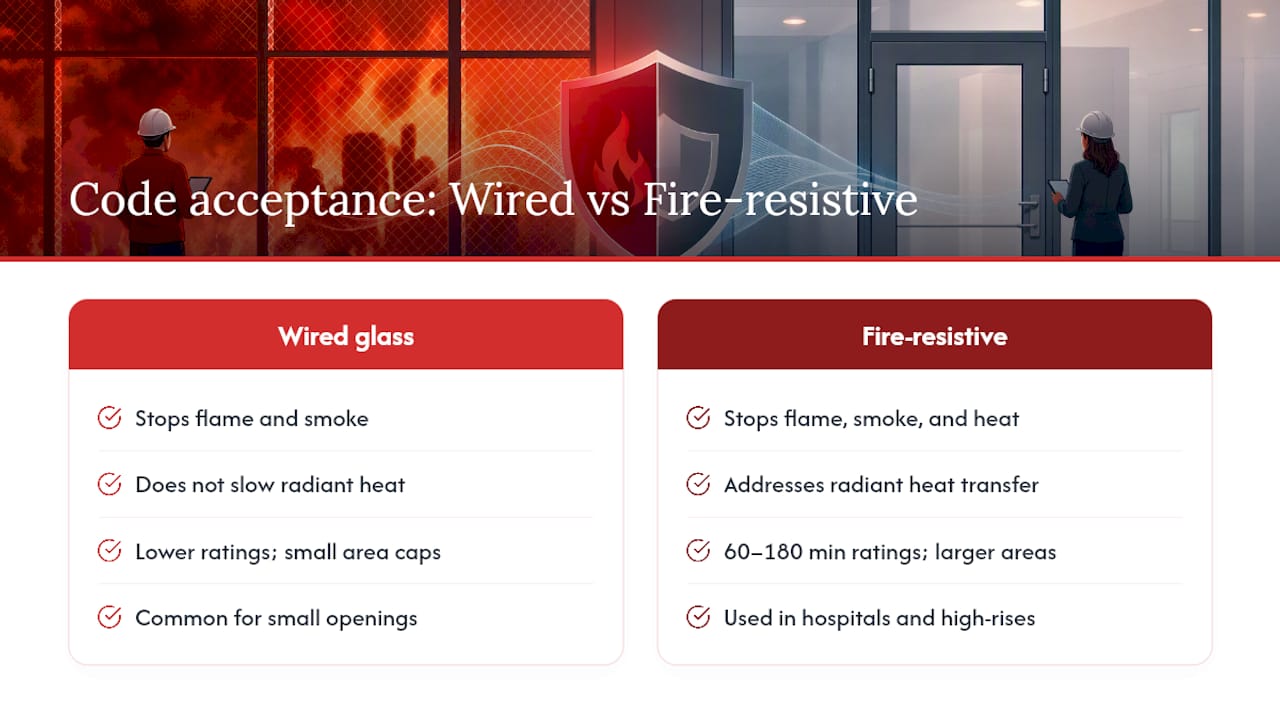
Codes don’t treat all fire-rated glazing the same way, and that distinction trips up a lot of specifiers moving between project types; for a detailed overview, see Fire Protection of Building Structures – An overview - INTEGRA Consulting Services. Wired glass gets code acceptance as fire-protective glazing, meaning it stops flame and smoke but does not meaningfully slow radiant heat transfer. Fire-resistive glazing, ceramic products and multi-layer glass-and-interlayer systems tested to ASTM E119 or UL 263, gets accepted for a broader range of applications specifically because it addresses that radiant heat gap.
The practical result: any project requiring a 60 to 90-minute rating with a glazed area larger than the small caps allowed for specialty wired glass products will need fire-resistive glazing instead. There’s no way to size your way around that limit with standard wired glass. Some ceramic and laminated fire-resistive products carry ratings up to two or three hours with much larger allowable areas, which is why hospitals, high-rises, and other demanding occupancies lean toward them for large lites and sidelites.
For lower ratings and smaller openings, wired glass often remains the more economical and widely available choice, provided the impact-safety requirements are addressed. The decision usually comes down to three factors: the required rating, the allowed exposed area, and whether the location counts as hazardous under impact-safety rules. Get those three answers first, and the correct glazing category becomes obvious rather than a judgment call.
What Actually Matters When You Specify Wired Glass
The conventional advice on wired glass treats it like a single product category with one fire rating, and that’s where a lot of specifiers get into trouble. Wired glass isn’t one thing. It’s a range of products with wildly different performance depending on whether it’s been filmed, how it was tested, and what frame it’s paired with. Treating a 45-minute unfilmed product and a 90-minute filmed assembly as interchangeable is the single most common mistake I see repeated across submittal packages.
The industry also underemphasizes documentation relative to the physical product. Everyone focuses on whether wired glass is “fire rated,” but the real risk sits in the paperwork gap between what was ordered and what actually shipped. A supplier’s catalog claim isn’t a test report. If you take nothing else from this, take this: request the assembly listing before you request a price quote, not after.
Prioritize the hose stream result and the impact classification over the minute rating alone. Those two data points tell you more about whether a product will actually clear inspection than the headline number ever will.
— Esteban
Get Compliant Fire-Rated Door Assemblies Without the Delay
When a vision panel fails inspection or a project deadline is closing in, waiting weeks for documentation isn’t an option. The company offers fire-rated steel doors and frames with options for quick delivery, along with installation and maintenance services to support contractors and property managers needing compliant assemblies promptly.
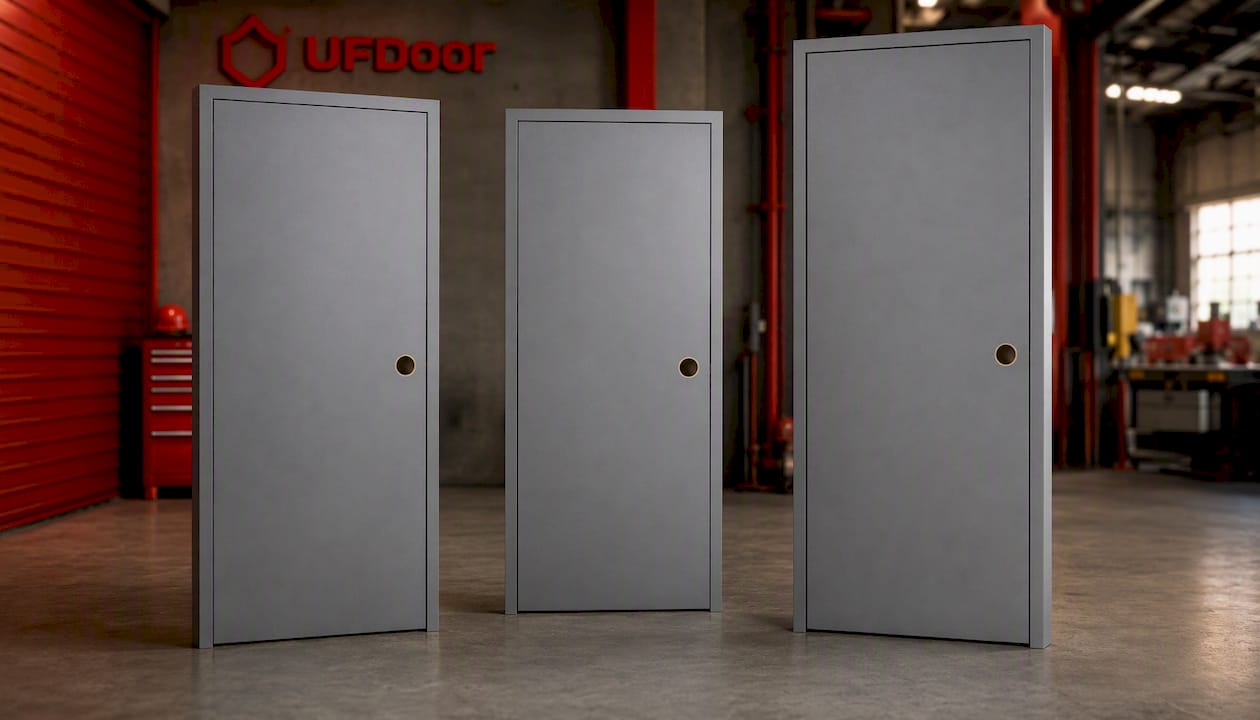
Before you order, ask for the product’s test listing and label photos so you know exactly what’s shipping. Ufdoors offers 90-minute fire-rated door slabs in standard sizes including 32 x 96 configurations for taller openings, each built to documented ratings that hold up during plan review and inspection. Reach out for a quote and get the specific lab report and label documentation attached before the door ever leaves the shop.
Standards to Attach to Your Submittal
Keep these references in every glazing submittal package: NFPA 252 and NFPA 257 for fire test methods, UL 10C and UL 9 for door and window assemblies, ASTM E119 for fire-resistive glazing comparison, and CPSC 16 CFR 1201 alongside ANSI Z97.1 for impact safety. Save the manufacturer’s lab report and reference NFPA 80 guidance in your operations and maintenance file for future inspections.
Sources
- IBC Code Revisions to Fire-Rated Glass in Doors
- Wired Glass | Glass Magazine
- Is Wired Glass Safe? Fire Ratings, Codes, and Limits - LegalClarity
- Use of wired glass in doors (UpCodes summary)
FAQ
Is wired glass fire rated?
Yes, wired glass commonly carries a fire-protective rating of 20 to 45 minutes, and select filmed products are listed up to 60 or 90 minutes under strict size limits. It is not fire-resistive and does not block radiant heat the way ASTM E119-tested glazing does.
What are the cons of wired glass?
Monolithic wired glass fails modern impact-safety tests and is banned from hazardous locations without an approved safety film, and it also struggles with the hose stream test required for ratings above 45 minutes. It’s also vulnerable to wire corrosion in wet or humid environments over time.
How thick is 45-minute fire-rated glass?
Standard wired glass used in 45-minute assemblies is typically about 1/4 inch thick, with specific wire gauge and mesh size requirements set by the product’s test listing. Exposed glazing area at 45 minutes is capped at 1,296 square inches under current IBC guidance.
Is wire glass legal?
Wired glass is legal when it’s used within its tested rating, size limits, and, in hazardous locations, when paired with an impact-safety film tested as part of the same assembly. Monolithic wired glass without that film is prohibited in hazardous locations under current code editions.