
$400–$1,800 Installed: Fire Door Cost for Homeowners & Managers

Expect to pay roughly $400 to $1,800 per installed fire door, with commercial units running higher depending on rating, doorset type, and site work. Get a site survey before you commit to a number: frame condition and hardware specification move the price more than most quotes admit upfront.
TL;DR:
- Fire door prices vary significantly depending on rating, size, and hardware, with commercial units often costing more than residential options.
- The primary cost factors include door material, fire rating, whether a prehung units or slab, and the condition of existing frames.
- Hardware and seals certified for fire resistance can add between $150 and $300 per door, with extra costs for security upgrades and structural remediation.
- Installation costs typically range from $200 to $500 per door, with permits and inspections adding another $50 to $300, especially for more complex jobs.
- DIY installation is only feasible for simple slab swaps in suitable frames; most jobs require a certified professional to ensure compliance and pass inspections.
Table of Contents
- What Does a Fire Door Cost to Install?
- Why Do Fire Door Quotes Vary So Much?
- How Do Materials and Fire Ratings Affect Price?
- What Do Labor, Permits, and Maintenance Cost?
- Can You Install a Fire Door Yourself, or Should You Hire a Pro?
- How Does a Specialist Supplier Handle Pricing and Delivery?
- A Buyer’s Checklist for Fire Door Quotes
- Get a Fast, Compliant Fire Door Quote
- Sources
- FAQ
What Does a Fire Door Cost to Install?
The fire door cost you see quoted depends heavily on whether you’re replacing a slab or a full doorset, and whether the job is residential or commercial. HomeAdvisor puts the normal installed range at $400 to $900, averaging around $650, with premium or custom installations reaching $1,350. Angi reports a similar split: materials run $300 to $600, installation adds $200 to $500, landing most residential jobs in that same $400 to $900 band.
Supply-only pricing sits well below supply-and-fit quotes, since labor, hardware, and disposal get bundled into the fitted price. If you’re comparing quotes, always confirm which category you’re looking at.
- Internal FD30 door (supply and fit): $400–$700 (roughly £400–£700 in the UK, per Fire Risk Assessment Network)
- FD60 door (supply and fit): $600–$1,100
- Glazed fire door with vision panel: add $150–$400 over a solid-leaf equivalent
- Flat entrance or communal door: $900–$1,800+, driven by added security hardware and certification paperwork
- Double-leaf or custom-size doorset: $1,200–$2,500, depending on width and rating
- Commercial 90-minute steel door: $1,000–$2,000 installed, per Current Cost’s commercial price survey
Regional variance is real and it isn’t small. If you’re pricing a job in a major metro, budget toward the top of these ranges rather than the average, and don’t be surprised if a downtown high-rise quote runs well past a suburban single-door replacement for the same rating.
Why Do Fire Door Quotes Vary So Much?
Two doors with the same fire rating can carry wildly different price tags, and the gap almost always traces back to a handful of specific variables rather than the door itself.
Fire rating and materials come first. A 20-minute rated slab costs less than a 90-minute steel door, and jumping from FD30 to FD60 typically adds noticeable cost in both material thickness and required hardware. Commercial buyers should note that larger openings and higher ratings compound quickly: a 4-foot by 8-foot, 120-minute doorset can add 20% to 40% over a standard 3-by-7, 60 to 90-minute unit.
Doorset format matters more than most buyers expect. A prehung doorset (door plus frame, already assembled and tested as a unit) costs more upfront than a slab-only replacement, but it guarantees the fire performance is certified as a system. Swapping just the slab into an old frame is cheaper, but only works if that frame is still square, undamaged, and rated to match.
Frame condition is the single biggest source of quote creep. Installers repeatedly report that tolerance correction and frame repair are the most common reasons a final invoice exceeds the initial estimate. A site survey catches this before it becomes a change order.
Hardware packages are where a lot of homeowners get caught off guard. Certified hardware isn’t optional on a fire door. It’s part of what makes the door legally a fire door.
- Self-closing hinges and certified closers: required on virtually every fire-rated doorset
- Intumescent seals around the frame: expand under heat to block smoke and flame
- Cylindrical or mortise locksets rated for fire doors
- Vision panels or glazing, if specified, using fire-rated glass only
Hardware and ironmongery alone commonly add $150 to $300 per door, and that’s before you factor in upgraded security hardware for entrance doors. Site access and structural remediation round out the list: a door on the third floor of an occupied building costs more to install than one on a ground-floor storage room, and if the surrounding wall or header needs work, that’s a separate line item entirely.
How Do Materials and Fire Ratings Affect Price?
Material choice sets your baseline, and rating sets your ceiling. Here’s how the common options stack up.
- Hollow metal (steel): the industry standard for commercial and many residential fire doors. Durable, resistant to warping, and widely available in 90-minute ratings. Installed cost typically runs $500 to $2,000 depending on size and hardware.
- Solid-core wood: common in residential and hospitality settings where appearance matters. Costs are comparable to steel at lower ratings (FD30) but climb fast at FD60 and above, since thicker cores and specialized cores are needed to hit the rating.
- Composite: blends a wood or laminate face over a fire-resistant core. Good middle ground on cost and appearance, though availability varies by supplier and lead times can run longer than steel.
- Fire-rated glass: used in vision panels or full glazed doorsets. Adds meaningfully to cost per square foot but is often required by code in corridors and stairwells where visibility matters.
Choosing between FD30 and FD60 isn’t just a cost decision. It’s a code decision, and it depends on what the door separates. A door between a garage and living space typically needs a different rating than a door protecting a stairwell in a multifamily building. Upgrading a spec from FD30 to FD60 generally adds a few hundred dollars per door once hardware and thicker cores are factored in.
Prehung doorsets cost more than a slab swap, usually by $100 to $300, but they remove the guesswork around frame compatibility. If your existing frame is old, warped, or unrated, a prehung unit is almost always the safer buy even at the higher price.
What Do Labor, Permits, and Maintenance Cost?
Labor typically runs 2 to 4 hours per door for a standard replacement, more if the frame needs rework or the opening requires structural adjustment. Per-door labor costs commonly fall in the $200 to $500 range, consistent with the installation-only split Angi reports for residential work.
Permits and inspections add a smaller but real line item. Expect permit fees in the $50 to $300 range, and if a post-installation certification visit is required, budget another $75 to $200 for that inspection. Not every jurisdiction requires a permit for a like-for-like door swap, but changing the opening size, the rating, or the wall assembly usually triggers one.
- Old door removal and disposal: often bundled into labor, but ask if it’s itemized separately
- Delivery fees for custom sizes or rush orders: $50 to $150 depending on lead time
- Annual inspection and maintenance: many commercial properties budget $50 to $150 per door per year for compliance checks
What gets missed most often: certified closers, rated hinges, and intumescent seals. These hardware items frequently add several hundred dollars to a job that homeowners initially priced using only the door slab cost.
If you’re replacing multiple doors in an occupied building, coordination and access management add time beyond the per-door price, but bundling several doors into one job usually lowers the per-door rate enough to offset that overhead.
Can You Install a Fire Door Yourself, or Should You Hire a Pro?
Some fire door tasks are within reach for a competent DIYer. Most are not, and the reasons are regulatory, not just practical.
- Replacing a slab in a frame you’re not touching structurally is sometimes feasible if you have carpentry experience and the frame is confirmed square and rated.
- Any job involving a new opening, frame replacement, or wall modification needs a certified installer, since the fire rating depends on correct clearances and tested hardware combinations.
- Certification and inspection sign-off almost always requires a licensed contractor, because inspectors need documented proof the doorset was installed to the tested specification.
- Common DIY mistakes that add cost later include using non-rated hardware, oversized gaps around the frame, and skipping intumescent seals, all of which can fail inspection and require redoing the work.
The math usually favors professional installation once you price in a failed inspection, a redo, or a fine for non-compliance. When you do hire out, ask for the installer’s certification documentation and a copy of the test standard and report for the doorset. A “supply-only” quote often leaves out hardware compatible with that specific rating, so confirm exactly what’s included before you sign.
How Does a Specialist Supplier Handle Pricing and Delivery?
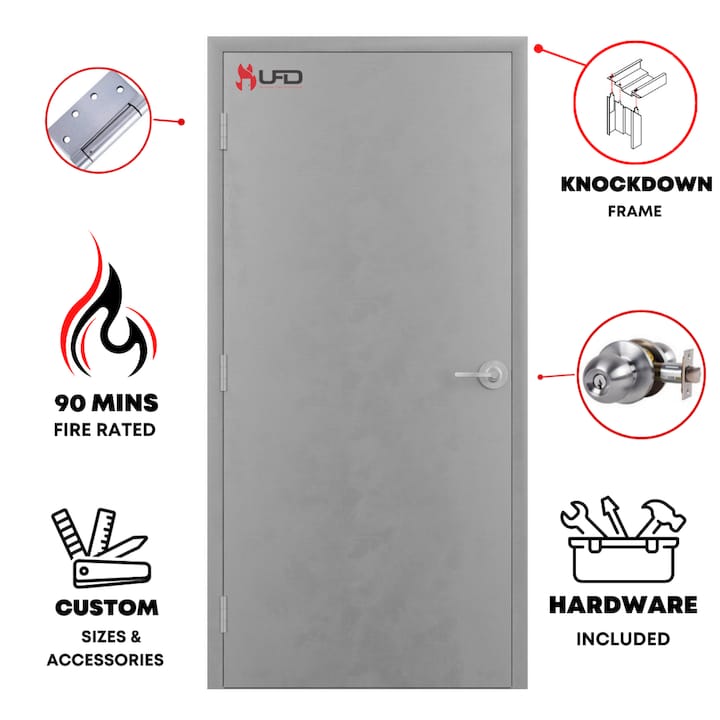
A specialist fire door supplier maps buyers to specific products rather than one-size-fits-all quotes. A straightforward replacement, for example, typically points to a 30 x 80 steel door slab with a single cylindrical prep, 20 gauge, rated 90 minutes, suited to buyers who just need the leaf swapped into a sound frame.
If the frame itself is damaged or out of tolerance, the fix is a 32 x 84 knock-down steel door frame, built for retrofit jobs where the existing opening needs a fresh, code-compliant frame without a full wall rebuild. For buyers who want the whole job solved in one purchase, a complete 32 x 84 steel door unit with frame, self-closing hinges, and cylindrical lockset covers the doorset and hardware as a matched, tested system.
- Same-day or next-day delivery matters most when a failed inspection or emergency repair is on the clock
- Full-service installation removes the certification risk that comes with DIY or unlicensed labor
- Always request the certificate of performance and installation evidence before final payment
Pro Tip: Ask your supplier for the test report number on the doorset, not just a verbal confirmation of the rating. Inspectors want documentation, not assurances.
A Buyer’s Checklist for Fire Door Quotes
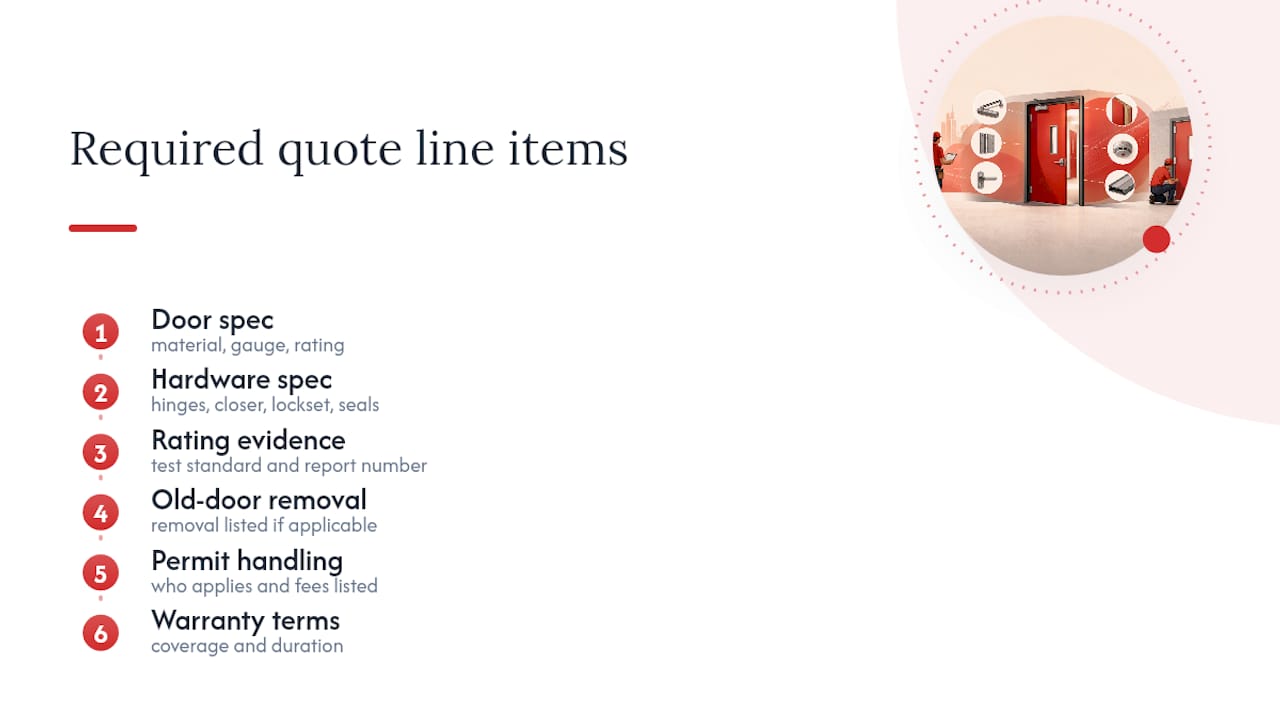
Every quote you collect should list the same line items, and if one is missing, ask why. Door spec (material, gauge, rating), hardware spec (hinges, closer, lockset, seals), evidence of the rating (test standard and report number), old door removal, permit handling, and warranty terms all belong on paper before you sign anything.
Volume pricing is worth pushing for if you’re replacing more than a handful of doors in one building. Staged works, meaning a few doors now and the rest over a following quarter, can also soften cash flow without losing the bulk discount if your supplier is willing to lock pricing across phases.
On fix versus replace: a door that fails on hardware or seals alone is usually cheaper to repair. A door with a compromised core, warped frame, or the wrong rating for its location should be replaced outright. Patching a rating problem doesn’t hold up to inspection.
— Esteban
Get a Fast, Compliant Fire Door Quote
A practical alternative to piecing together a fire door job from separate suppliers, installers, and permit runners offers same-day or next-day delivery on certified steel doors and frames to avoid weeks-long delays in case of failed inspections or emergency replacements, with full-service installation maintaining certification paperwork in one place rather than scattered across multiple vendors.
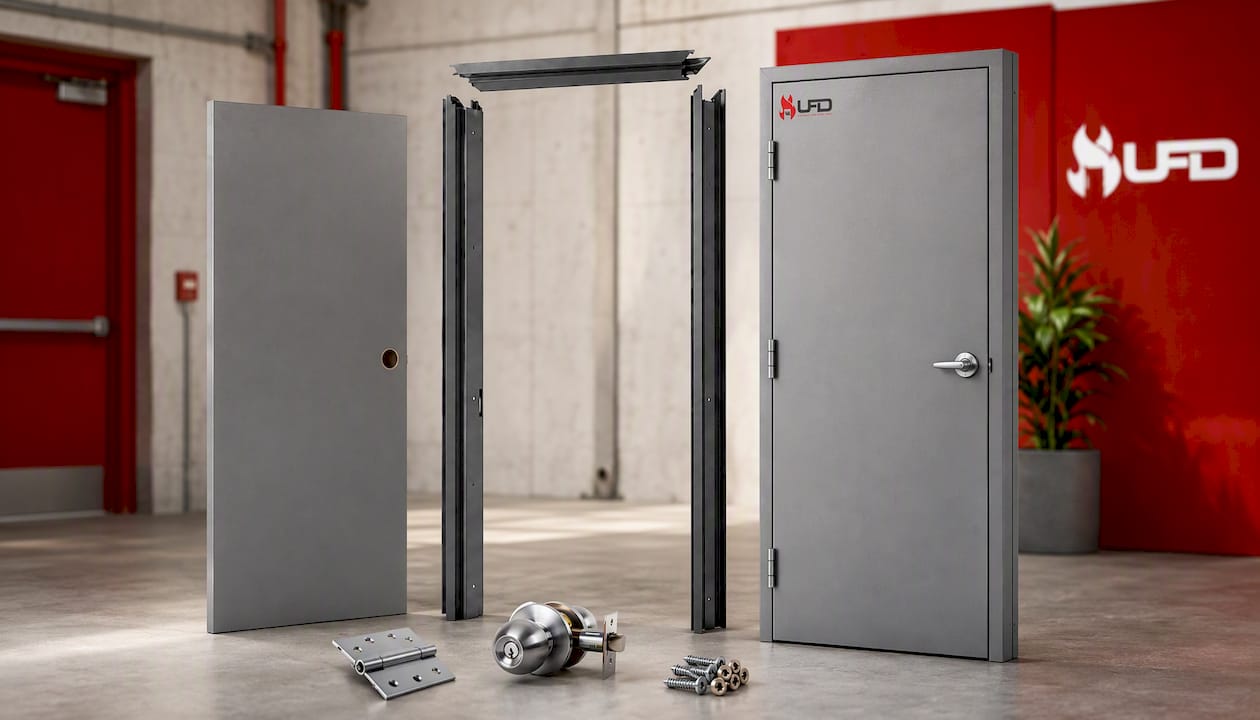
If you already know your rating and size, the 30 x 80 steel door slab, 90-minute rated is stocked and ready for standard replacements. If your frame needs work too, pair it with the 32 x 84 knock-down frame, or skip the matching entirely with the complete 32 x 84 steel door unit with hardware included. Request a site survey and a written quote that specifies fire rating and certified hardware before your next project deadline.
Sources
These sources back the cost figures in this guide and are worth revisiting if you need region-specific detail:
- How Much Does It Cost to Install a Fire Door? 2025 Data | HomeAdvisor
- How Much Does a Fire Door Cost? 2026 Data | Angi
- Fire Door Replacement Cost UK: What Affects the Price? | Fire Risk Assessment Network
- Commercial fire door prices: what U.S. buyers typically pay and what drives cost 2026 – Current Cost
Always confirm requirements with your local building or fire code authority, since fire door specifications and permit rules vary by jurisdiction.
FAQ
What Is the Typical Cost of Installing a Fire Door?
Most homeowners pay $400 to $900 installed for a standard residential fire door, averaging around $650, while higher-spec or flat-entrance doors can run $900 to $1,800 or more.
What Is the Average Cost of a Fire-Rated Door?
The average lands near $650 installed for a residential FD30 door, according to HomeAdvisor, though commercial 90-minute steel doors average closer to $1,000 to $2,000.
Is There Really That Much Difference Between a Regular Door and a Fire-Rated Door?
Yes. A fire-rated door uses a solid or specially rated core, intumescent seals, and certified hardware tested as a system, which typically costs several hundred dollars more than a standard interior door of the same size.