
Facility Managers: Fire Door Labeling That Passes IBC and NFPA 80

A compliant fire door label shows a traceable manufacturer ID, a third-party certification mark from an agency like UL, Warnock Hersey, QAI, or Intertek, and a fire protection rating in minutes or hours. Temperature-rise and smoke (“S”) markings appear when the opening’s location requires them. If a label is missing, painted over, or unreadable, schedule a field evaluation with an accredited agency or replace the door with a factory-labeled assembly. Do not leave the opening undocumented.
TL;DR:
- Fire door labels must display a traceable manufacturer ID, third-party certification mark, and fire protection rating; missing or unreadable labels require field evaluation or replacement.
- Field evaluations compare the existing door assembly against certified configurations; if they match, a supplemental label is issued, otherwise full replacement is necessary.
- Routine inspections should verify label presence, readability, hardware compliance, and seal integrity, with photographic records kept for documentation.
- Label markings specify fire resistance duration, temperature-rise limits, and smoke control, with certification marks confirming tested hardware and glazing configurations.
- Compliance relies on adherence to IBC and NFPA 80 standards, with local amendments possibly adding requirements; keep all inspection records and documentation for AHJ reviews.
Table of Contents
- What Information Must Appear on a Fire Door Label
- How Does Field Evaluation and Relabeling Work?
- Inspection and Maintenance Checklist for Fire Door Labels
- What Do the Ratings and Markings on a Fire Door Label Actually Mean?
- What Codes Govern Fire Door Labeling Requirements?
- Missing or Unreadable Label? Here’s What to Do Next
- How Ufdoors Supports Fire Door Labeling Compliance
- A Practitioner’s Note on Label Compliance
- Get Compliant Doors and Labeling Support Fast
- Primary Standards and Testing-Agency Resources
- Sources
- FAQ
What Information Must Appear on a Fire Door Label
A fire door label is a legal document riveted to steel. Building departments and fire marshals treat it as proof the assembly passed a real fire test, not a guess based on how thick the door looks.
The IBC requires three non-negotiable elements: the manufacturer’s name or a traceable identification number, the mark of the third-party inspection agency that certified the door, and the fire protection rating itself. Interior exit stairways and ramps also need a maximum transmitted temperature marking in many jurisdictions.
Beyond those basics, QAI’s labeling guidance lists supplemental items you’ll find on most compliant labels:
- Minute rating wording (20, 30, 45, 60, 90, or 180 minutes)
- Test standard reference and a serial or control number for traceability
- “DO NOT REMOVE OR COVER” and “SEE INSTALLATION INSTRUCTIONS” statements
- Minimum bolt throw specification, where hardware requires it
- “S” designation for smoke and draft control, when applicable
Factory labels typically get applied to the top third of the door on the hinge side, a placement convention that keeps them visible during inspection without interfering with the closer or hardware. Field-applied labels follow the same placement rule when the certifying agency signs off.
How Does Field Evaluation and Relabeling Work?
When a door is missing its factory label but the hardware, gasketing, and frame still look original, a field evaluation is often faster and cheaper than tearing the assembly out. A trained field labeling technician, working under an accredited testing lab, inspects the door slab, frame, hinges, closer, glazing, and gasketing against the lab’s own listing criteria, described in typical field labeling service overviews.
The process generally runs like this:
- The technician documents existing hardware, dimensions, and any prior modifications.
- They compare the assembly against a listed configuration the lab already tested.
- If it matches, they apply a supplemental label or issue a certificate referencing a listing report number.
- If it doesn’t match, either a repair path is outlined or full replacement is recommended.
Full replacement becomes the only option when a door has been altered beyond what any listing covers, such as unauthorized cutouts or a mismatched frame. Turnaround for a straightforward field evaluation often runs a few days to a couple of weeks, depending on agency availability and how many openings need review.
Pro Tip: Ask the field labeling agency for the listing report or W/N number before the visit. Cross-checking that number later saves you a second trip if the AHJ has questions.
Inspection and Maintenance Checklist for Fire Door Labels
Routine inspection catches label problems before an AHJ does. Facility teams checking a batch of openings should confirm:
- The label is present, legible, and matches the required rating for that location
- Hardware, including bolt throw and latching, matches what the label specifies
- Gasketing and smoke seals are intact with no gaps
- No unauthorized field modifications, like added vision lites or undocumented hardware swaps
- The door closes, latches, and seals correctly under normal operation
Photograph every label during inspection and file the image with the opening’s serial number and any field-label certificate. That single habit turns a stressful AHJ walkthrough into a five-minute records pull instead of a scramble.
Most facilities check fire door labels annually alongside standard fire door inspections, with additional review triggered immediately after any repair, hardware change, or direct AHJ request.
What Do the Ratings and Markings on a Fire Door Label Actually Mean?
Fire door labels use shorthand that looks cryptic until you know the code. A few conventions cover most of what you’ll see in the field:
- Minute ratings (20 to 180 minutes) indicate how long the assembly resists fire in a standardized test; higher ratings apply to stairwells and areas requiring longer egress protection.
- Temperature-rise statements, often 250°F, 450°F, or 650°F measured over 30 minutes, apply mainly to doors in exit enclosures and limit how much heat transfers through the door face, not just flame.
- The “S” marking signals smoke and draft control compliance, which requires listed gasketing rather than a generic weatherstrip.
- Certification marks from UL, Warnock Hersey, Intertek, or QAI each reference a specific listing report. Locate that report number on the label to confirm the exact hardware and glazing combination the door was tested with.
What Codes Govern Fire Door Labeling Requirements?
Two documents anchor almost every fire door labeling requirement your local AHJ will cite.
The IBC sets the baseline: manufacturer identification, third-party agency mark, fire protection rating, and temperature-rise marking where the location demands it. NFPA 80 fills in installation detail, covering minimum hardware throw, required clearances, and how labels must be worded and physically installed. Model code extracts compiled by UpCodes confirm labels must be approved and permanently affixed, either at the factory or wherever fabrication happens, and that oversized doors not covered by a standard fire test can carry a certificate of inspection instead.
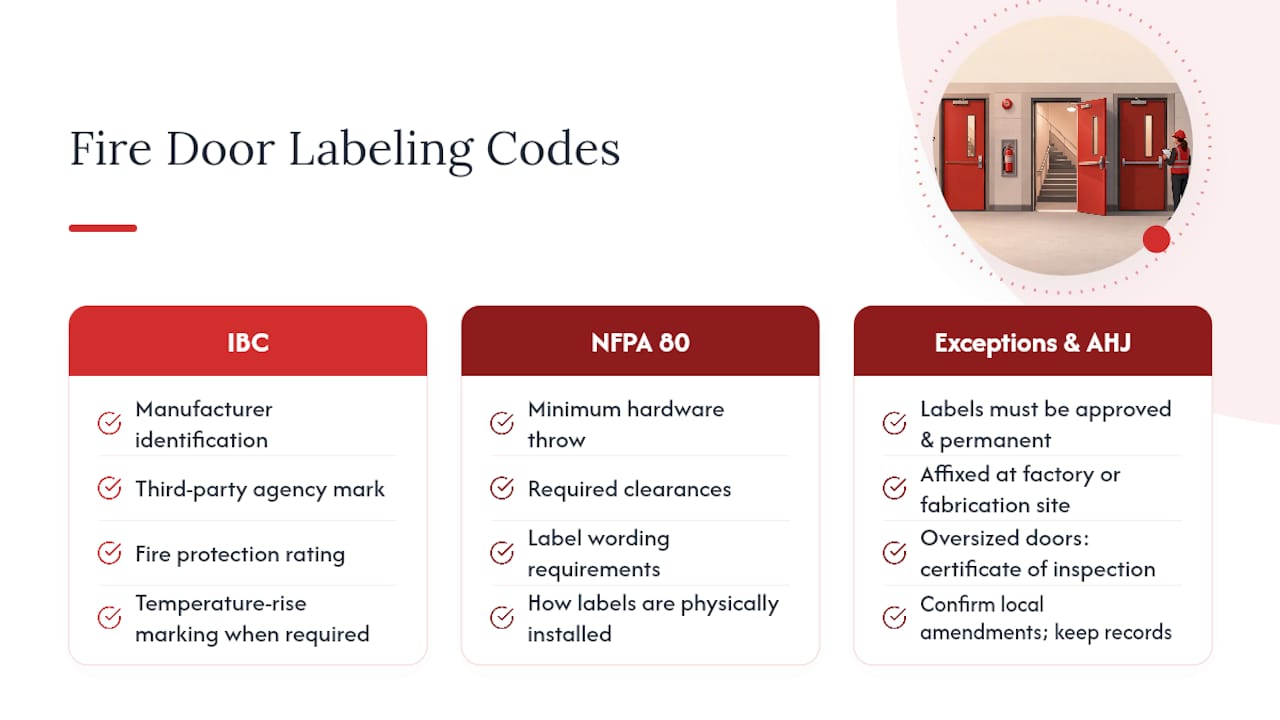
Local AHJs sometimes layer amendments on top of these baseline codes, so confirm current local requirements and keep certificates, labels, and inspection reports on file as your compliance evidence.
Missing or Unreadable Label? Here’s What to Do Next
- Verify the door still closes, latches, and seals properly, then photograph the label area exactly as found.
- Note the opening’s location and rating requirement so you know what listing you need to match.
- Schedule a field evaluation with an accredited agency, or plan for factory replacement if the door has been heavily modified.
- Submit the resulting certificate, photos, and listing reference to your AHJ, and keep a copy in your compliance file.
Costs and timelines vary by agency and region, but most owners can expect a field evaluation to resolve faster than sourcing a fully custom replacement door.
How Ufdoors Supports Fire Door Labeling Compliance
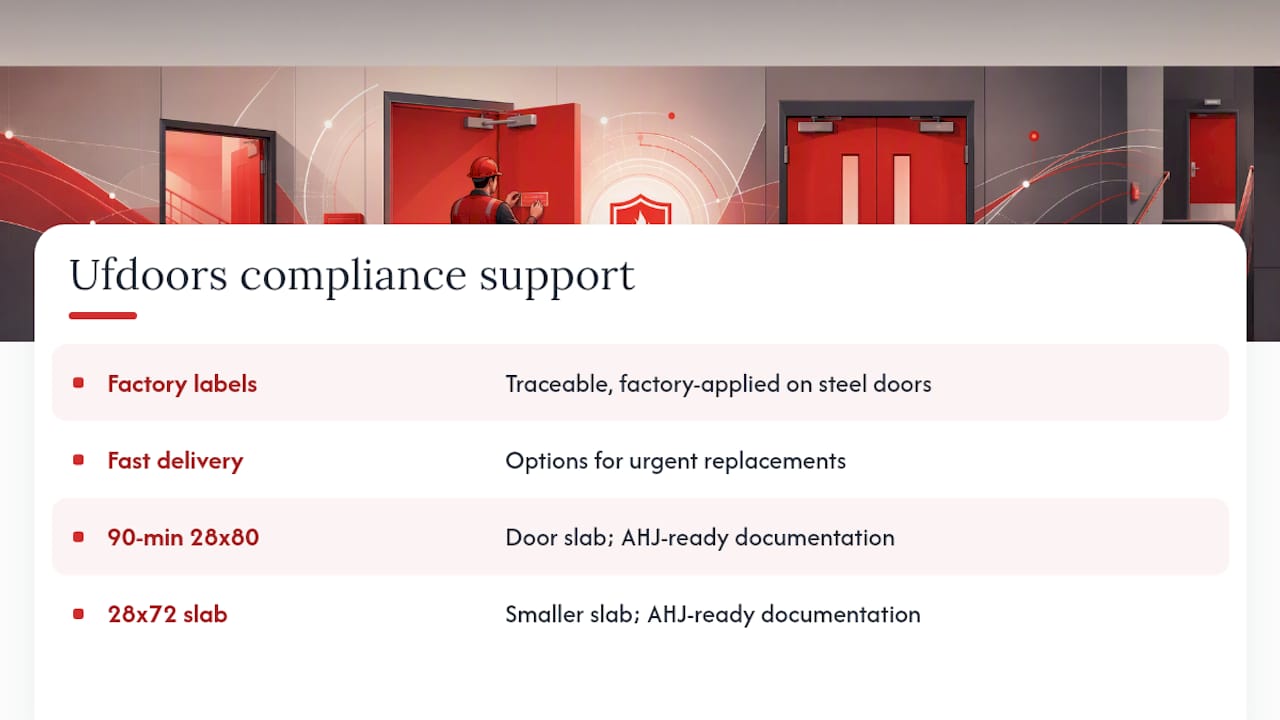
Fire-rated steel doors with traceable, factory-applied labels are available, sometimes with fast delivery options for urgent replacements. Options like a 90-minute fire-rated 28x80 door slab or the smaller 28x72 door slab arrive with documentation ready for AHJ review, reducing the paperwork friction that trips up owners during inspection season.
A Practitioner’s Note on Label Compliance
Most label failures aren’t dramatic. They’re a coat of paint applied during a routine repaint, or a label torn off during a hardware swap nobody documented. Building a photo record of every label, before anything gets touched, is the cheapest insurance in facility management. When you do need a field evaluation, book it before your next scheduled inspection, not after an AHJ flags the door.
— Esteban
Get Compliant Doors and Labeling Support Fast
The company offers an alternative to waiting weeks for a custom order when a fire marshal flags an opening. Some manufacturers produce their own fire-rated steel doors and hardware, with replacement units sometimes shipping promptly and arriving with the labeling and documentation needed for AHJ review, potentially avoiding separate field evaluation if a new factory-labeled assembly is used.
If your compliance issue is hardware rather than the door itself, a UL 3-hour fire-rated lever lockset can resolve a bolt-throw mismatch without touching the slab. For openings that need a full swap, the 90-minute 28x80 slab and 28x72 slab cover two of the most common commercial dimensions. If your opening needs a closer look before you order, Ufdoors also offers fire door inspection services to confirm what you actually need. Contact Ufdoors for a site evaluation or to place an emergency replacement order today.
Primary Standards and Testing-Agency Resources
- UL Door and Window Marking Guide
- QAI fire door labeling requirements
- Intertek field labeling guidance
- UpCodes fire door labeling requirements
Sources
- Field Labeling of Fire Doors
- Fire door labeling requirements (QAI)
- Door and Window Marking Guide (UL)
- Fire Door Labeling Requirements (UpCodes)
FAQ
Are All Fire-Rated Doors Labeled?
Yes. A fire-rated door without a valid label isn’t considered compliant, regardless of how it was built, because the label is what ties the physical door to its certified test results.
Where Can I Find Fire-Rated Door Labels for Sale?
Legitimate fire door labels aren’t sold separately. They come from the manufacturer at the point of fabrication or get applied by an accredited field labeling agency after an on-site evaluation.
What Signage Should Be on a Fire Door?
Beyond the certification label itself, many jurisdictions require visible signage such as “Fire Door: Keep Closed” on doors intended to remain shut, separate from the manufacturer’s fire rating label.
What Is the Code for Fire Doors?
The IBC and NFPA 80 govern most fire door labeling and installation requirements in the United States, though local AHJs may add amendments, so confirm current requirements with your local building department.
Can Ufdoors Help if My Fire Door Label Is Missing?
Ufdoors supplies factory-labeled replacement doors with fast delivery and offers installation support, giving building owners a documented path to compliance without waiting on a lengthy custom order.