
$400–$900 Vs £300–£600: Fire Door Installation Costs 2026 for Owners & Managers

Most homeowners pay $400 to $900 installed per fire door in the US, averaging $650, while UK property owners typically pay £300 to £600 for a compliant FD30 internal door. Steel doors, commercial retrofits, and structural frame work push both figures higher. Fire rating, door material, and labor complexity drive nearly every cost swing you’ll see on a quote.
TL;DR:
- US fire door installation costs range from $400 to $900 for standard residential doors, while commercial and steel options can reach up to $2,800 depending on complexity.
- UK prices for fully installed FD30 internal doors usually fall between £300 and £600, with higher prices for entrance or steel doors in commercial settings.
- Higher fire ratings, such as FD60 or FD90, increase costs due to denser materials and certified hardware, often requiring structural modifications and additional labor.
- Reusing existing frames, scheduling multiple doors at once, and opting for standard sizes can significantly lower overall expenses without compromising safety.
- Accurate quotes should itemize hardware, materials, labor, permits, and documentation separately to avoid hidden costs and ensure code compliance.
Table of Contents
- How Much Does Fire Door Installation Cost?
- What Factors Affect Fire Door Installation Prices?
- How Do US and UK Fire Door Costs Compare?
- Which Door Type and Hardware Combination Costs What?
- What Happens During Fire Door Installation?
- Do You Need a Permit or Certification for Fire Doors?
- How Can You Lower Fire Door Costs Without Cutting Corners?
- Why Trust This Fire Door Cost Guide?
- A Property Manager’s Take on Budgeting for Fire Doors
- Ready to Get a Fire Door Installation Quote?
- Sources
- FAQ
How Much Does Fire Door Installation Cost?
Supply-only pricing and full installed pricing tell two different stories, and mixing them up is the fastest way to misjudge a quote.
A standard timber internal fire door slab alone often runs $150 to $400 in the US before labor. Add installation, and the typical installed range lands between $400 and $900, averaging around $650 for straightforward residential jobs. Steel or commercial-grade doors change the math substantially. Heavier systems with structural retrofitting frequently land in the $900 to $2,800 range, depending on the building and door system involved.
In the UK, a fully installed compliant FD30 internal door commonly costs £300 to £600, while entrance doors or higher-spec units rated for communal or commercial use often reach £600 to £1,200 or more.
Here’s how the bands typically stack up:
- US supply-only, standard timber door: $150 to $400
- US supply and install, residential: $400 to $900 (average $650)
- US supply and install, steel or commercial: $900 to $2,800
- UK supply and install, FD30 internal: £300 to £600
- UK supply and install, entrance/higher-spec: £600 to £1,200+
Local labor rates, permit fees, and documentation charges shift every one of these bands. A quote that ignores those line items usually isn’t comparing apples to apples with the ranges above.
What Factors Affect Fire Door Installation Prices?
Reading a quote intelligently means knowing which line items are negotiable and which reflect real code requirements.
Fire rating sets the floor. A 20-minute or FD20 door costs less than an FD30, and both are cheaper than a 60-minute or 90-minute rated unit. Higher ratings typically require thicker cores, denser materials, and certified components throughout, which raises both material and labor cost.
Material matters almost as much. Timber doors are the budget option for residential interiors. Steel or hollow metal doors cost more upfront but hold up better in high-traffic commercial settings and heavier fire ratings like 90-minute assemblies.
Frame work is where budgets often blow past expectations. Reusing an existing frame keeps costs down if it’s square, undamaged, and rated for the new door. A new frame, especially one requiring structural modification to the opening, adds both material cost and hours on site.
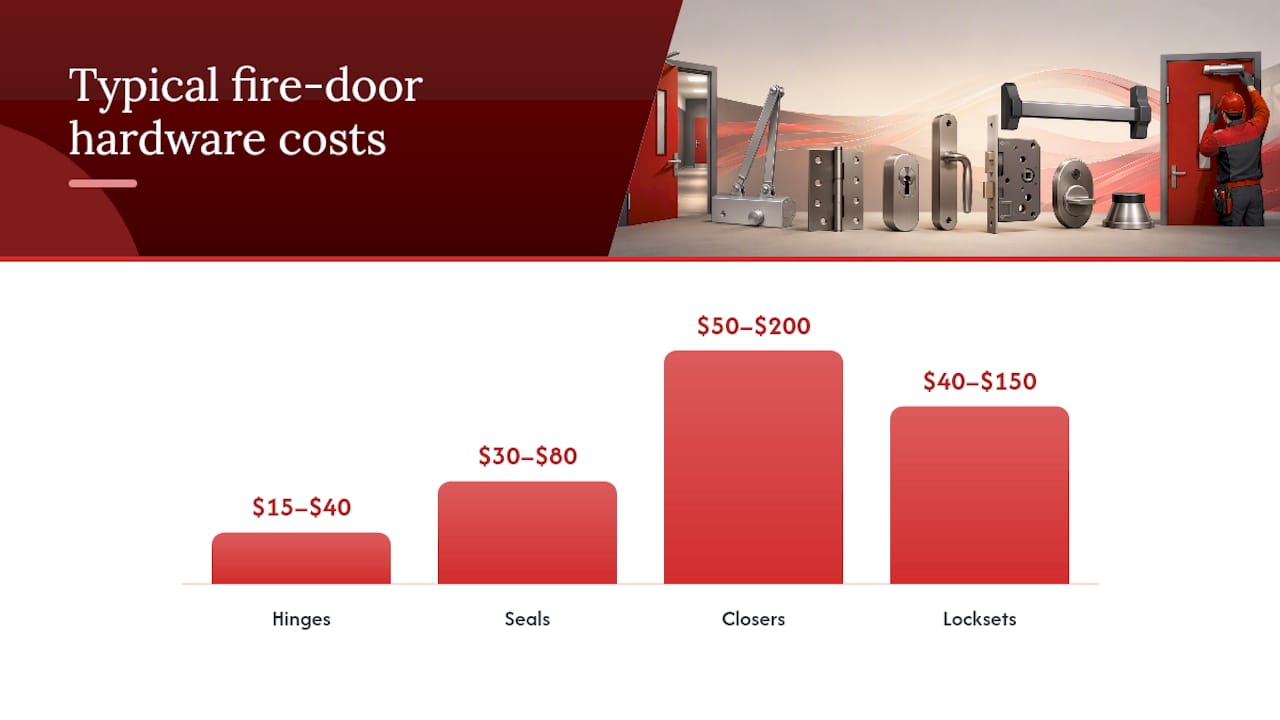
Hardware and seals are non-negotiable on a certified fire door and add up fast:
- Certified fire-rated hinges: $15 to $40 each
- Intumescent and smoke seals: $30 to $80 per door
- Fire-rated door closers: $50 to $200
- Certified locksets: $40 to $150
Labor rates for door installers commonly run $40 to $125 per hour depending on region and specialization, with a straightforward residential fit taking 2 to 3 hours. Structural repairs, uneven jambs, or relocated services can double that time.
Permits, disposal, and finishing round out the invoice. Old door disposal, jamb repair, painting or staining, and municipal permit fees are common catch-alls that rarely appear in a headline price.
Pro Tip: Ask every installer to break out labor hours separately from materials on the quote. If one bid buries everything into a flat “installed price,” you can’t tell whether you’re paying for extra labor or just a markup.
How Do US and UK Fire Door Costs Compare?
The two markets price fire doors differently because labor structures, certification norms, and typical door specs aren’t the same.
In the US, sample scenarios often look like this: a single interior residential fire door with standard hardware runs $400 to $650 installed. A steel door replacement in a multifamily corridor, including new frame and certified hardware, commonly reaches $1,200 to $2,800. Bundled “doorset” pricing, where the slab, frame, and hardware are sold as one certified package, is increasingly common in commercial bids and tends to simplify comparison.
In the UK, the baseline is the FD30 internal door at £300 to £600 fully fitted. Entrance doors, steel doors in communal blocks, or anything requiring intumescent strips and self-closing devices push toward £600 to £1,200+, and FD30 remains the most common residential specification, with entrance and steel doors driving the upper end.
A few things to check before comparing quotes across regions or currencies:
- Confirm whether the quote is supply-only or supply-plus-install.
- Check whether certification documentation and labels are included or billed separately.
- Ask if the price reflects local labor rates or a national average.
- Verify the fire rating quoted matches what your building code actually requires.
Municipal inspection practices and certification expectations vary enough between jurisdictions that a “cheap” quote in one city may simply be skipping a step that’s mandatory somewhere else.
Which Door Type and Hardware Combination Costs What?
Door type dictates most of your budget before hardware even enters the picture.
Internal timber FD30 doors are the most affordable option, running roughly £300 to £600 installed in the UK or $400 to $650 in the US for standard residential jobs. They cover the bulk of interior compartmentation needs in homes and low-rise apartment buildings.
Glazed and entrance doors cost more because fire-rated glazing and certified thresholds are specialized components. Vision panels need fire-rated glass and matching intumescent glazing tape, which adds both material cost and installation time.
Steel or hollow metal doors become necessary in commercial corridors, stairwells, and high-traffic communal areas where 90-minute ratings are standard. A 32 x 84 steel door slab with a 90-minute fire rating or a 32 x 76 equivalent represents the kind of standard commercial spec that shows up repeatedly in property manager budgets.
Hardware line items to budget for:
- Fire-rated closers with certified fire pins
- Intumescent and smoke seals matched to the door’s rating
- Certified hinges rated for the door’s weight and fire class
- Locksets and panic hardware compatible with the frame system
One warning worth repeating: a mismatched leaf, frame, or hardware combination can void the entire door’s fire certification, even if every individual component is rated correctly on its own. The system has to be certified as a whole, and a mismatched closer or an incompatible replacement frame can undo that.
What Happens During Fire Door Installation?
A compliant installation follows a fairly consistent sequence, and knowing the steps helps you spot a rushed job before it becomes a compliance problem.
- Site survey to confirm opening size, fire rating requirement, and frame condition.
- Removal of the existing door and, if needed, the frame.
- Frame installation or repair, including packing and squaring the opening.
- Door hanging with certified hinges and hardware fitted to spec.
- Seal and closer installation, including intumescent and smoke seal strips.
- Testing and commissioning, checking clearances, closing force, and seal contact.
A straightforward residential fit typically takes 2 to 3 hours, while commercial retrofits with frame replacement or fire-stopping around the opening can run a full day or more per door. Structural repairs, glazing fit, and finishing work all add hours. Ask installers to quote labor hours separately from add-on work so you can see exactly what’s driving the total.
Do You Need a Permit or Certification for Fire Doors?
Certification and paperwork are where a technically correct installation can still fail an inspection.
A compliant handover typically includes door and frame labels, third-party test evidence, an installation statement, and an itemized hardware list. Property managers increasingly need this “golden thread” of documentation retained for insurance and audit purposes, not just for the initial inspection.
Permit and inspection fees vary widely by jurisdiction, so get a local figure rather than assuming a national average applies. Before signing off on a quote, confirm it addresses:
- Whether labels and test certificates are included in the price
- Who files for the permit, if one is required
- Whether an installation statement will be provided for your records
- How documentation is stored for future inspections or insurance claims
Skipping this paperwork is a common way projects pass a visual check but fail a formal audit months later.
How Can You Lower Fire Door Costs Without Cutting Corners?
A few tactics reliably bring costs down without touching safety margins.
- Batch multiple doors on one visit. Scheduling several installs together commonly reduces per-door mobilization and certification fees.
- Prep the site beforehand. Clear access and remove old hardware yourself if you’re comfortable doing so.
- Reuse frames when they qualify. A square, undamaged, correctly rated frame saves both material and labor cost.
- Choose standard finishes and sizes. Custom stains or non-standard dimensions add cost fast.
- Request itemized quotes that separate labor, materials, hardware, and documentation.
Pro Tip: Never DIY a fire-rated door where certification is required for code compliance, such as stairwells, corridors, or rental units. Uncertified installation or mismatched hardware can void the fire rating entirely, and that’s a liability no property manager wants discovered during an insurance claim.
Prioritize egress routes and common-area doors first. Those carry the highest life-safety weight and the most compliance scrutiny.
Why Trust This Fire Door Cost Guide?
Ufdoors specializes in manufacturing and installing fire-rated steel doors, frames, and hardware built to meet NYC fire and safety compliance standards, which puts real installation and certification experience behind these numbers. They offer fast delivery along with a full-service model covering installation and ongoing maintenance, and have built trusted partnerships with a broad client base across contracting and property management sectors.
For readers who want a deeper technical breakdown of fire ratings and how to match a door to code requirements, the fire-rated doors ratings and requirements guide covers the selection process in detail. If you have documented case studies or client project results, they belong here to reinforce the practical track record behind these figures.
A Property Manager’s Take on Budgeting for Fire Doors
Egress routes and shared corridors should get upgraded before anything else. Those are the doors inspectors flag first and the ones that matter most if something goes wrong.
Before requesting quotes, gather your door count, current frame condition, expected foot traffic, and the fire rating your code requires. Vague requests get vague, inflated quotes. Specific ones get accurate ones.
Set a recurring inspection schedule and keep every certification document on file. It’s the cheapest insurance you’ll ever buy for a compliance audit.
— Esteban
Ready to Get a Fire Door Installation Quote?
If the numbers above have you budgeting for a full retrofit rather than a single door swap, a direct manufacturer and installer of fire-rated steel doors can provide a faster path than sourcing a slab, a frame, and certified hardware from three separate vendors. Such providers may offer same-day or next-day delivery alongside supply, installation, and maintenance handled by one team, which can cut coordination delays that usually stretch commercial retrofits.
Browse standard sizes like the 32 x 76 steel door slab or the 28 x 72 steel door slab to see what’s in stock right now. If your project involves a handful of interior doors with a straightforward opening, a local tradesperson may still be the simpler route. But for commercial-grade steel doors, tight compliance deadlines, or multi-door projects across a property, request a quote through the full product and service catalog and get a survey scheduled.
Sources
- How Much Does It Cost to Install a Fire Door? 2025 Data — HomeAdvisor
- Fire door installation cost — MyBuilder price guide
- Fire Door Installation Cost: What You’ll Pay in U.S. Markets — Well Built Florida
FAQ
How Much Should It Cost to Install a Fire Door?
Most US homeowners pay $400 to $900 installed, averaging around $650, for a standard residential fire door. UK homeowners typically pay £300 to £600 for a compliant FD30 internal door, with entrance and steel doors reaching higher.
How Much Does a 90-Minute Fire-Rated Door Cost?
A 90-minute rated door, often a steel or hollow metal unit like a 32 x 84 steel door slab, typically costs more than a standard 20 or 30-minute door because of denser core materials and heavier certified hardware. In commercial US settings, these installed costs often land between $900 and $2,800 depending on frame work and site access.
Can I Install a Fire Door Myself?
DIY installation risks voiding the door’s fire certification if hardware, seals, or clearances aren’t installed to spec. For doors protecting egress routes, common areas, or rental units, professional installation with documented certification is the safer and often legally required path.
How Much Will a Big Box Retailer Charge to Install a Door?
Big box retailers typically quote standard interior door installation rather than certified fire-rated systems, and their installers may not carry fire door certification credentials. For compliant fire-rated installs, a specialist supplier that can document certification and provide labels and test evidence, such as Ufdoors, is generally the better fit.