
Three Hinges for a 7-Foot Door: Fire Door Hinge Rules for Specifiers

For code-compliant fire doors, specify steel or stainless steel hinges that carry a UL listing, sized per NFPA 80, and paired with a listed self-closing and self-latching device. Confirm the hinge count matches door height, that leaf thickness meets the assembly’s rating, and that any spring hinge used as a closer is Grade 1 under ANSI/BHMA A156.17. The next step is simple: pull the door’s listing label and match your hardware order against it before you order anything.
TL;DR:
- Fire-rated hinges must be steel or stainless steel with UL listings and meet NFPA 80 specifications, including size, leaf thickness, and hinge count based on door dimensions.
- Regular inspection should verify fastener security, hinge alignment, label presence, and proper operation, with documentation required annually.
- Use of spring hinges requires listing, Grade 1 certification, and at least two hinges when used as the sole self-closing device; standard hinges distribute load better over multiple cycles.
- Proper hinge placement and fastening—top hinge about 5 inches from the top, bottom about 10 inches from the bottom, with steel fasteners—is critical to prevent door sagging or failure.
- When specifying hardware, consider environment, traffic cycles, and load capacity, and always use tested assembly configurations to ensure UL and fire safety compliance.
Table of Contents
- Types of Fire-Rated Hinges and When to Specify Each
- Codes and Standards You Must Follow
- Specification Checklist for Choosing Hinges and Closers
- Installation: Hinge Placement, Fasteners, and Common Errors
- Inspection and Maintenance: Annual Checklist and Priorities
- Troubleshooting and Retrofit Options
- How Universal Fireproof Doors Supports Compliance
- Fire Door Hinge Weight Ratings and Load Capacities
- Fire Test Procedures Specific to Hinges
- Effects of Hinge Damage or Wear on Fire Door Performance
- Impact of Hinge Type on Fire and Smoke Performance
- Author Perspective: Practical Procurement and Maintenance Priorities
- Order Listed Doorsets and Installation From Ufdoors
- Sources
- FAQ
Types of Fire-Rated Hinges and When to Specify Each
Four hinge types cover almost every fire-rated door application, and picking the wrong one is one of the most common reasons a doorset fails inspection.
Butt hinges (also called ball-bearing hinges) are the standard choice for most commercial fire doors. NFPA 80 requires labeled fire doors to hang on steel ball-bearing or otherwise listed hinges, not the plain-bearing hinges you’d find on an interior closet door. Ball bearings reduce friction at the pivot point, which matters because a fire door closer has to overcome that friction every single cycle, sometimes tens of thousands of times over a door’s service life, according to Proudman Fire’s breakdown of common hinge failures.
Spring hinges double as a self-closing device. They’re compact and popular on interior doors where a visible closer arm is unwanted, but they come with real limitations. NFPA 80 requires at least two spring hinges when they’re used as the sole closing mechanism, and they must be listed and meet Grade 1 under A156.17.
Continuous hinges (also called piano hinges) run the full height of the door instead of three or four discrete points. They distribute weight across dozens of pivot points rather than concentrating stress at a handful of screws, which makes them a strong pick for high-traffic doors, oversized leaves, or doors that see abuse from carts and equipment.
Pivots mount at the top and bottom of the door rather than along the hinge edge. They’re common on heavy doors, wide doors, and doors with unusual proportions where standard butt hinges can’t carry the load without excessive stress on the frame.
A few practical notes on sizing and materials:
- Standard 4-1/2" hinges with a 0.134" leaf thickness are the minimum for 1-3/4" doors up to about 4 feet wide and 8 feet tall.
- Heavier or larger doors require 0.180" leaf thickness, sometimes called heavyweight.
- Base material must be steel or stainless steel. Brass, aluminum, and zinc die-cast bases are not acceptable unless they’re part of a specifically listed assembly, according to Waterson’s plain-English breakdown of NFPA 80 hinge rules.
- In corrosive or high-humidity environments (pool facilities, coastal properties, parking structures), stainless steel earns back its higher upfront cost through fewer replacements.
Codes and Standards You Must Follow
Three documents govern nearly every hinge decision on a fire-rated door: NFPA 80, the International Building Code, and the ANSI/BHMA hardware standards. Skipping any one of them is how doors end up failing inspection years after installation.
NFPA 80 is the technical backbone. It specifies hinge material, minimum leaf thickness, and hinge count by door size, and it requires that labeled fire doors hang on steel ball-bearing or listed hinges rather than generic hardware store equivalents. Standard weight (0.134") 4-1/2" hinges are acceptable minimums for 1-3/4" doors up to 4 feet wide and 8 feet tall; anything larger typically bumps you up to 0.180" leaf thickness, according to the Steel Door Institute’s technical data series on fire door requirements.
Fire door hardware requirement snapshot: NFPA 80 bases minimum hinge quantity on door height, generally about one hinge per 30 inches or fraction thereof, with two hinges as an absolute minimum on any door. A typical commercial 7-foot door usually requires three hinges; taller doors may need four.
ANSI/BHMA standards fill in the performance details NFPA 80 references but doesn’t spell out in full. A156.1 covers standard butt hinges, A156.17 governs spring hinges (including the Grade 1 requirement for self-closing applications), and A156.26 addresses continuous hinges. When a spec sheet says a hinge is “Grade 1,” that’s an ANSI/BHMA performance classification, not a marketing term, and it tells you the hinge passed a defined cycle and load test rather than just looking sturdy.
IBC Section 716.2.6 ties the hardware requirement directly into the building code enforcement chain. It requires fire door hardware and closures to be installed in accordance with the code and NFPA 80, and it reiterates that fire doors must be self-closing and self-latching except in specifically permitted cases, per the International Code Council’s published IBC 2021 text. This is the section an inspector cites when a door is found propped open with no automatic closer, or when hardware doesn’t match what the label calls for.
UL listings work at two levels, and confusing them is a frequent, expensive mistake. A component listing means the hinge itself passed UL’s hardware testing. An assembly listing means the entire doorset, door, frame, hinges, closer, and lockset together, was tested and rated as a unit. Swapping a listed hinge into a doorset that wasn’t tested with that specific hinge can technically void the assembly’s label, even though the hinge itself carries a UL mark. That’s why NFPA 80 also mandates annual inspection and documentation of the full assembly, not just spot checks on individual parts.
Specification Checklist for Choosing Hinges and Closers
Before you cut a purchase order, run through five variables that determine which hinge and closer combination actually belongs on a given doorset.
- Fire-rating duration. A 20-minute door and a 90-minute door don’t always share hardware requirements. Confirm the tested assembly’s rating before assuming a hinge that worked on one project transfers to another.
- Door width and height. This drives both hinge count and leaf thickness. Measure first, then check it against the manufacturer’s sizing table rather than defaulting to whatever was on the last order.
- Expected cycle count. A stairwell door in an office building might see 200 cycles a day. A back-of-house kitchen door might see 2,000. Higher cycle counts justify continuous hinges or an extra butt hinge beyond the code minimum.
- Environment. Coastal air, chlorine exposure, or constant moisture calls for stainless steel over standard steel, regardless of what the code minimum technically allows.
- Budget constraints. Weigh upfront hardware cost against replacement frequency. A cheaper hinge that fails in three years costs more over a decade than a heavier one that lasts fifteen.
On the decision between spring hinges and separate closers: spring hinges work fine for lighter-use interior doors where simplicity matters more than fine latching control. For doors that see heavy traffic or need reliable positive latching from any open position, a listed door closer paired with standard ball-bearing hinges tends to hold up better over time than relying on spring tension alone.
Before you finalize an order, request four documents from any supplier: the UL or listing reference number for the hinge, the ANSI/BHMA grade classification, the tested assembly report showing which hardware combination was actually fire-tested, and the manufacturer’s installation instructions. A commercial door hardware guide can help you cross-check compatibility between hinges, closers, and locksets before you commit to a purchase.
Pro Tip: NFPA 80’s hinge counts and leaf thicknesses are minimums, not recommendations. On a door that opens more than a few hundred times a day, specify one size or one hinge count above the code floor. The incremental cost is small compared to an emergency service call six months after installation.
Installation: Hinge Placement, Fasteners, and Common Errors
Correct placement and fastening determine whether a properly specified hinge actually performs like the label promises. Get this wrong and even a UL-listed hinge can allow the door to sag out of tolerance within a year.
Common industry placement practice puts the top hinge about 5 inches from the top of the door and the bottom hinge about 10 inches from the bottom, with intermediate hinges spaced evenly between them. NFPA 80’s hinge-count rule (roughly one hinge per 30 inches of door height, minimum two) determines how many total hinges you need before you start spacing them.
Fasteners matter more than most installers assume. The specifics:
- Steel machine screws into door reinforcement for hollow metal doors.
- No. 12 x 1-1/4" steel wood screws for mortise hinges set into wood or composite doors, with pilot holes required to prevent splitting.
- A 5/32-inch pilot hole for this No. 12 wood screws significantly cuts the risk of strip-out, a detail worth writing directly into your purchase order rather than leaving to the installer’s judgment.
- Steel through-bolts for any surface-mounted hinge application.
- Shims, when needed for alignment, must be steel. A plastic or wood shim compromises the fire rating at the hinge point.
Two installation errors show up again and again on failed inspections. The first is undersized or wrong-type fasteners, particularly wood screws driven into hollow metal reinforcement without a pilot hole, which strips the threads and lets the hinge work loose within months. The second is covering or removing the door’s listing label during hinge replacement or painting, which leaves an inspector unable to verify the assembly at all, according to iDigHardware’s decoded review of NFPA 80’s hinge requirements. Both errors are avoidable with a five-minute checklist before the crew leaves the site.
Inspection and Maintenance: Annual Checklist and Priorities
NFPA 80 requires annual inspection and documented testing of every fire door assembly, hinges included, not just a visual walk-by. Section 5.2 of the standard specifies that inspections confirm hinge security, alignment, label presence, and that the door closes and latches from any open position.
- Check fastener security. Loose screws are the earliest warning sign of hinge failure. Tighten or replace before the door starts to sag.
- Inspect for corrosion. Rust on a hinge pin or leaf, especially in humid or coastal buildings, signals it’s time to consider a stainless steel upgrade rather than a like-for-like replacement.
- Verify the label is present and legible. A missing or painted-over label makes the door unverifiable regardless of hardware condition.
- Test self-closing and self-latching from multiple open positions, not just from fully open. A door that latches at 90 degrees but not at 30 degrees has a problem an inspector will catch.
- Document everything. Date, inspector, findings, and corrective action, kept on file for the AHJ.
Routine maintenance is mostly lubrication and pin replacement. A dry hinge pin creates the friction that eventually strains screws and reinforcement, so a light application of appropriate lubricant during annual service prevents bigger problems. When you find a hinge that’s undersized for the door’s actual use pattern, upgrading to a heavier weight during a scheduled repair is usually cheaper than repeating an emergency fix.
Pro Tip: Separate your corrective actions into two buckets: anything affecting self-closing or self-latching gets fixed immediately, since that’s a live life-safety issue. Cosmetic corrosion or minor fastener wear can go on a scheduled repair list, but document the timeline so it doesn’t quietly become permanent.
Troubleshooting and Retrofit Options
A door that sags, won’t latch, or squeals on every swing is usually telling you something specific about its hinges. Sagging almost always traces back to stripped fasteners or an undersized hinge for the door’s weight. Failed latching often means the door has shifted out of alignment, sometimes from a single loose hinge rather than a hardware defect. Noisy or binding hinges typically point to a dry or worn pin.
Fixes range from minor to significant:
- Replace fasteners with the correct type and re-torque, the cheapest and most common fix.
- Re-shim with steel shims to restore alignment without full hinge replacement.
- Add an extra hinge if the door sees more traffic than it was originally specified for.
- Upgrade to heavy-weight leaves or a continuous hinge if the problem keeps recurring despite repairs.
If a repair changes the hinge type or count from what the tested assembly specifies, check with the manufacturer before calling the job done. Some substitutions require re-testing or written manufacturer approval to preserve the listing, as noted in Proudman Fire’s guidance on hinge-related failures.
How Universal Fireproof Doors Supports Compliance
Ufdoors manufactures listed fire-rated steel doors, frames, and hardware, with same-day or next-day delivery and full installation, inspection, and repair services built around NFPA 80 compliance. That combination matters when a failed inspection or an emergency replacement puts you on a deadline.
Three ready-to-order doorset kits address the most common commercial specification needs, each including self-closing hinges and a cylindrical lockset: the 28 x 84 steel door unit, the 32 x 84 steel door unit for wider openings, and the 28 x 80 steel door unit for standard-height replacements. Request UL listing paperwork and tested-assembly documentation with any order to confirm the hardware matches your building’s requirements.
Fire Door Hinge Weight Ratings and Load Capacities
Hinge weight ratings describe how much door mass a hinge can support through its full cycle life without deforming or loosening at the mounting points. Standard weight hinges (0.134" leaf thickness) are rated for lighter commercial doors, typically up to 4 feet wide and 8 feet tall at standard thickness. Heavyweight hinges (0.180" leaf) carry a higher load rating and are required once door dimensions or door material push past that threshold.
Weight capacity isn’t only about the door’s static mass. A heavier door swinging shut hundreds of times a day puts repeated stress on the top hinge in particular, since it bears more of the door’s weight during the swing than the bottom hinge does. That’s why facilities with high-traffic fire doors, hospital corridors, loading dock entries, stairwell doors, often specify heavy weight hinges even when the door dimensions technically qualify for standard weight under NFPA 80’s minimums.
Continuous hinges change this calculation by distributing load across the door’s full height instead of concentrating it at three or four points. That’s part of why they’re a common upgrade for oversized or unusually heavy doors where a standard three-hinge configuration would otherwise need to be rated well above typical specifications. Pivots serve a similar function for doors where the hinge edge itself can’t support the load distribution required.
Under-rating a hinge for its actual door weight is one of the more expensive mistakes in fire door specification. It doesn’t always show up immediately. Sag develops gradually, sometimes over a year or more, until latching fails and the door needs hardware replacement anyway.
Fire Test Procedures Specific to Hinges
Hinges themselves aren’t tested in isolation the way you might test a fire-rated wall assembly. Instead, they’re evaluated as part of the complete doorset during a fire endurance test, where the hinge’s job is to keep the door hung, aligned, and functional under sustained high heat without failing at the mounting point.
During assembly testing, the door and frame are exposed to a standardized time and temperature curve inside a furnace, and the hinges have to hold the door in place, allow it to remain closed, and not deform in a way that opens a gap for fire or smoke to pass through. A hinge that warps, that has fasteners that back out under thermal expansion, or that separates from the door leaf causes the entire assembly to fail the test, regardless of how the door slab itself performs.
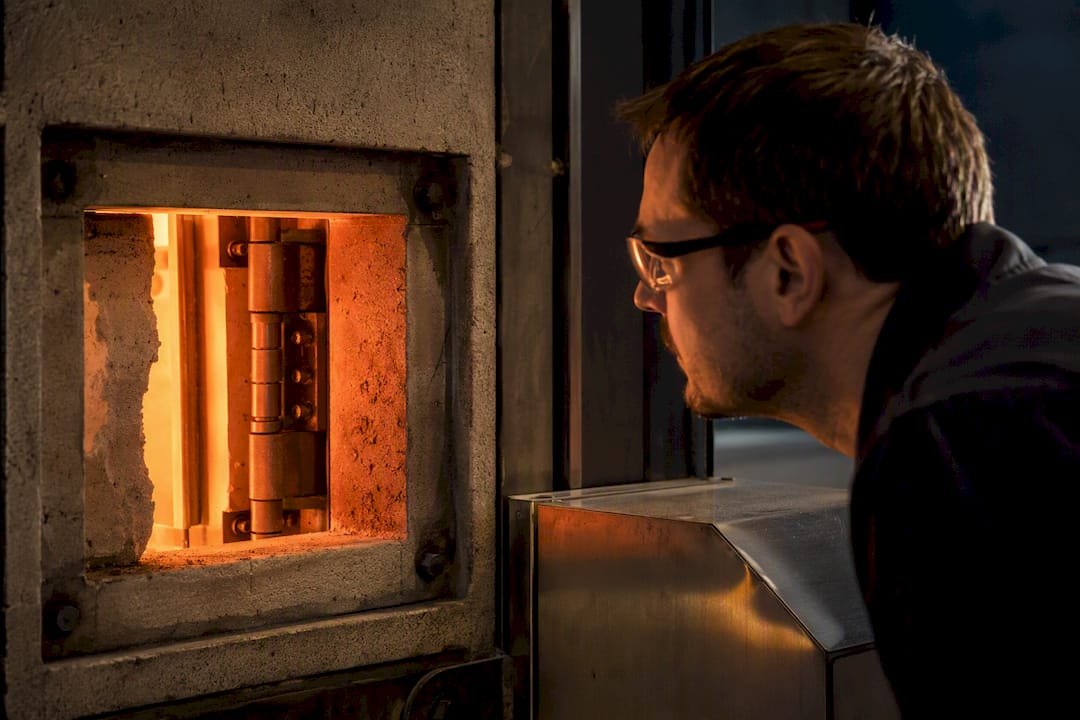
This is precisely why component substitution matters so much. A hinge with an individual UL listing was tested to hardware performance standards on its own, covering things like cycle life and mechanical strength. An assembly listing means that specific hinge, in that specific hinge count, on that specific door and frame combination, survived the full fire endurance test together. Swap in a different hinge, even a UL-listed one, and you’re outside the tested configuration unless the manufacturer’s documentation explicitly allows the substitution.
For high-temperature door hinge applications specifically, the steel or stainless steel base material matters because it needs to maintain enough structural integrity at elevated temperatures to keep functioning as a load-bearing pivot point, not just resist visible damage.
Effects of Hinge Damage or Wear on Fire Door Performance
A worn or damaged hinge doesn’t just squeak. It changes how the entire door behaves, and in a fire scenario, that change can be the difference between a door that seals an opening and one that doesn’t.
Worn hinge pins create play in the door’s swing, which throws off the tight tolerance between door and frame that a fire-rated assembly depends on. That gap, sometimes just an eighth of an inch, is enough to let smoke pass before the door’s intumescent seals have a chance to activate under heat. Loose or stripped fasteners let the door sag over time, which shifts the latch out of alignment with the strike plate and can mean the door simply won’t catch when someone pushes it closed, defeating the self-latching requirement entirely.

Corrosion is a slower but equally serious threat. A rusted hinge pin binds under load, which can prevent a self-closing device from fully swinging the door shut, especially in cold weather when metal contracts and friction increases. NFPA 80’s annual inspection requirement exists specifically to catch this kind of gradual degradation before it becomes a functional failure, since visible rust or a slightly loose screw rarely triggers an emergency call on its own.
The cumulative effect matters most. A single worn hinge on a three-hinge door doesn’t necessarily fail the door outright, but it does shift more load onto the remaining hinges, accelerating their wear too. That’s the mechanism behind doors that seem to fail all at once: the damage was building for months.
Impact of Hinge Type on Fire and Smoke Performance
Hinge type affects more than mounting convenience. It shapes how consistently a door achieves the tight closure a fire and smoke barrier depends on.
Continuous hinges distribute the door’s weight across their full length, which tends to keep the door edge parallel to the frame more consistently over years of use than a three-point butt hinge configuration. That consistency matters for smoke containment specifically, since smoke will find its way through even small, uneven gaps long before flames or heat compromise the barrier. A door that swings true, without a slight twist from an unevenly worn hinge, seals against its frame and door seals the way it was tested to.
Spring hinges introduce a different consideration. Because they combine the hinge and closing mechanism into one part, their self-closing tension can degrade gradually rather than failing all at once, which makes them harder to catch during a casual visual check. A door closer paired with standard hinges gives a facility manager a separate, more visibly monitorable component for closing force, which some property managers find easier to maintain reliably at scale.
Pivots, common on heavier and architecturally distinct doors, generally provide stable, predictable swing behavior because the load path runs straight through a single top and bottom point rather than across multiple hinge leaves. That predictability helps maintain consistent frame contact, which is exactly what smoke containment depends on. The hinge type you choose ultimately shapes whether the door closes the same way on its ten-thousandth cycle as it did on its first.
Author Perspective: Practical Procurement and Maintenance Priorities
The hardware world treats hinges as an afterthought next to the door slab itself, and that’s backwards. Listing verification and documented annual inspection catch the failures that actually happen: loose fasteners, worn pins, missing labels. On high-use doors, I’d rather see a facility manager specify one hinge weight class above the code minimum than save a few dollars per unit and gamble on cycle life. For straightforward replacements, in-house teams handle it fine; for anything touching the tested assembly configuration, bring in the manufacturer’s installation service instead of guessing at substitutions.
— Esteban
Order Listed Doorsets and Installation From Ufdoors
Ufdoors is the direct source for listed fire-rated doorsets when a failed inspection or an urgent replacement puts you on a clock most manufacturers can’t match. Same-day or next-day delivery on manufactured units means you’re not waiting weeks for a compliant door while a violation sits open, and certified installation plus inspection and reporting services mean the hardware goes in correctly the first time, matched to the assembly’s tested configuration.
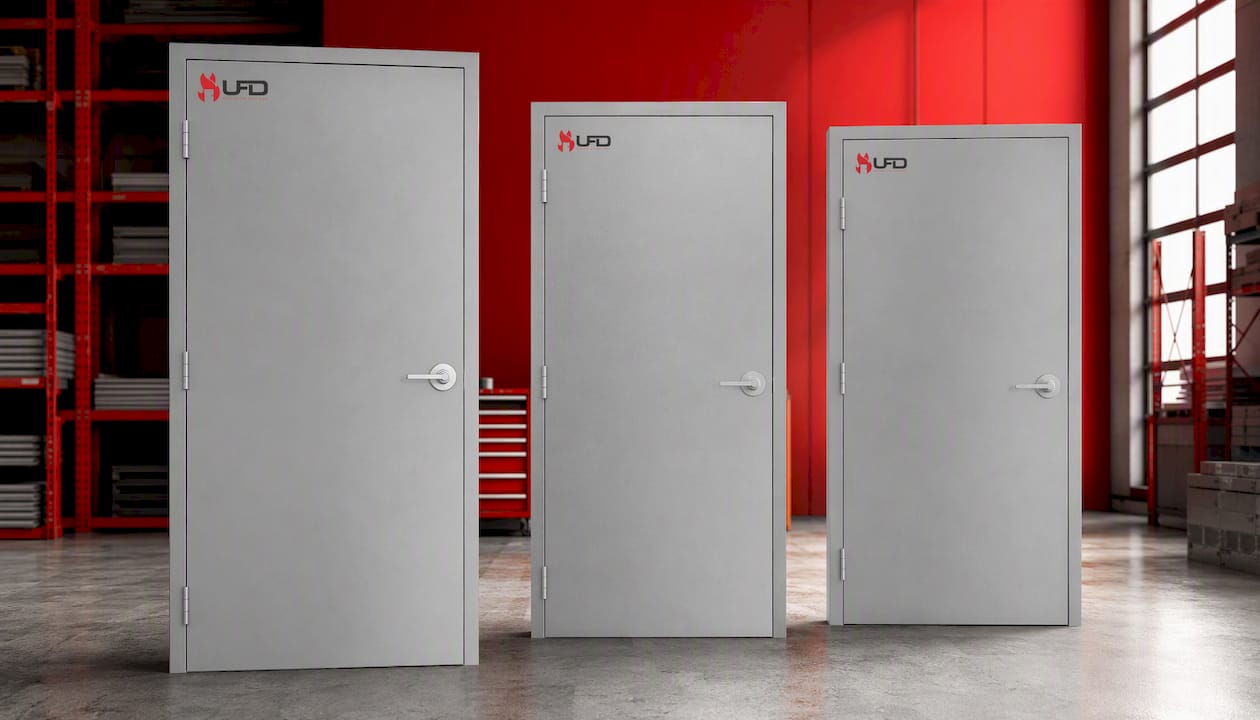
Three kits cover the most common commercial specifications, each shipped with self-closing hinges and a cylindrical lockset already matched to a tested assembly: the 28 x 84 steel door unit, the 32 x 84 steel door unit for wider door openings, and the 28 x 80 steel door unit for standard-height replacements. Request listing documentation, order the kit that matches your opening, and schedule installation, three steps between a compliance gap and a signed-off inspection.
Sources
- Tech Data Series: Basic Fire Door, Fire Door Frame, Transom/Sidelight Frame & Window Frame Requirements
- Fire Door Hinges Explained: Types, Ratings, Requirements & Common Problems - Proudman Fire
FAQ
Do Fire Doors Require Special Hinges?
Yes. Labeled fire doors must hang on steel ball-bearing or otherwise listed hinges, not standard residential-grade hardware, per NFPA 80. Non-ferrous materials like brass or aluminum are not acceptable unless part of a specifically listed assembly.
What Are the Hinge Requirements for Fire-Rated Doors?
Requirements cover material (steel or stainless steel), minimum leaf thickness (0.134" standard, 0.180" for larger or heavier doors), and hinge count based on door height, roughly one hinge per 30 inches with two as an absolute minimum. Any spring hinge used as a self-closing device must be listed and meet Grade 1 under ANSI/BHMA A156.17.
Where Should Fire Door Hinges Be Placed?
Common practice sets the top hinge about 5 inches from the top edge and the bottom hinge about 10 inches from the bottom, with additional hinges spaced evenly between them based on the required count for that door height. Placement should always follow the manufacturer’s tested assembly instructions rather than a generic rule alone.
Can Spring Hinges Be Used on Fire-Rated Doors?
Yes, spring hinges are acceptable as a self-closing device when they’re listed and meet ANSI/BHMA A156.17 Grade 1. At least two spring hinges are required when they serve as the sole closing mechanism, and NFPA 80 calls for adjustment to confirm the door latches from a 30 degree open position.
How Often Do Fire Door Hinges Need Inspection?
NFPA 80 requires annual inspection and documented testing of the full fire door assembly, including hinge security, corrosion, alignment, and self-closing and self-latching function. Ufdoors offers inspection and documentation services for facilities that need this handled on schedule.